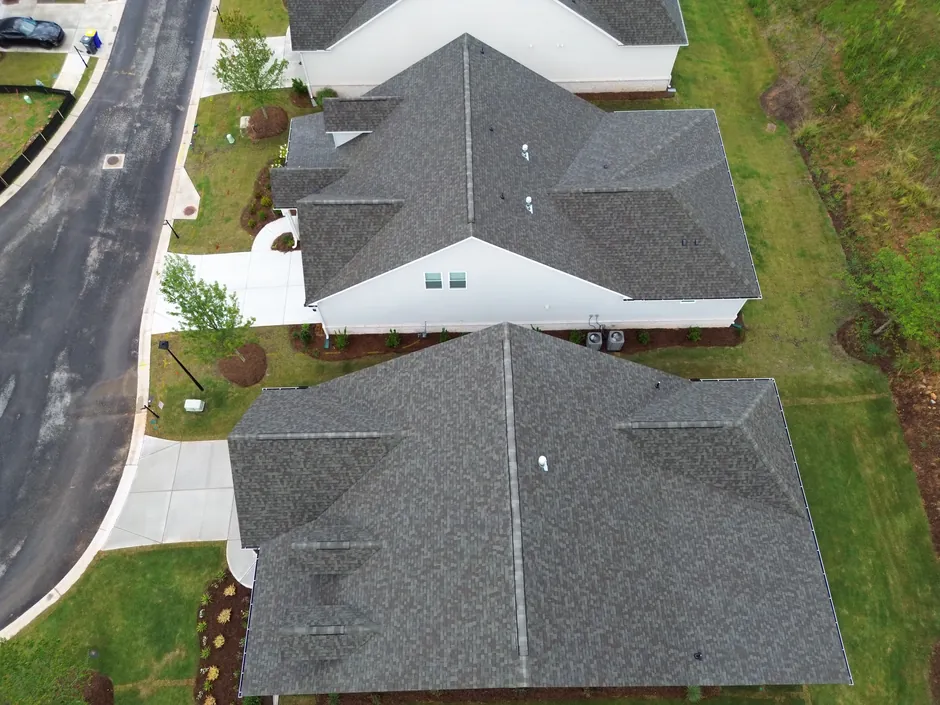
Hail is the quiet threat on an Alpharetta roof. Unlike a tree fall or a blown-off ridge cap, hail damage often looks like nothing from the driveway, which is exactly why it becomes expensive. A storm passes, the sun comes out, and a homeowner assumes the roof rode it out. Meanwhile, granules have been pulverized in thousands of spots, the fiberglass mat is exposed in others, and the clock on an insurance claim has started.
This guide covers how to recognize hail damage on every common roof type, why hail size matters to adjusters, North Fulton’s storm history, and the Georgia rules that shape a hail claim.
What hail damage looks like on asphalt shingles
The vast majority of Alpharetta homes are topped with asphalt shingles, either architectural (dimensional) or, on older homes, 3-tab. Hail damage on asphalt looks different from wind or impact damage, and once you know the pattern, it is hard to unsee.
Granule loss
Asphalt shingles protect themselves with a layer of mineral granules bonded to the surface. When hail strikes, it knocks granules loose. You might see:
- Bald spots where the dark asphalt mat shows through
- Piles of granules collecting in valleys and at downspout splash-outs
- A “peppered” look across a roof plane, meaning small dark specks in a random pattern
The key word is random. Hail does not follow shingle courses. If damage is concentrated along a single row, it is more likely foot traffic or installation damage.
Bruising
Bruising is the most diagnostic sign and the one adjusters look for. A bruise is a soft spot where the fiberglass mat has been fractured by impact but the granules are still mostly intact. Press your thumb against it and it gives slightly. This is a hands-on-the-roof finding, not a ground-level one.
Exposed fiberglass mat
When impact is harder or the shingle older, the granule layer breaks through and you can see the fiberglass mat underneath. Exposed mat accelerates UV breakdown dramatically. A shingle that might have lasted another 10 years can be effectively done within 2 or 3 seasons.
Pattern recognition
Hail damage is random in placement but consistent in orientation. On a roof that took a storm hit, impacts cluster on the slope the storm came from. Flashings, metal vents, and gutter aprons often show the clearest dents because metal deforms more visibly than shingle does.
Hail damage on metal, tile, and slate roofs
Alpharetta has a growing share of metal roofs, especially on modern farmhouse builds around Milton and Crabapple, plus tile and slate roofs on higher-end homes. Hail reads differently on each.
Metal roofs
Metal roofs, whether standing seam, stamped steel shingle, or aluminum, are the easiest surface for spotting hail. Look for round or oval dents on the flat pans, dents clustered on the slope facing the storm, and cracked or starred paint finishes.
Most modern metal systems carry an impact rating. IBHS publishes hail impact ratings that translate lab hail-simulation testing into product grades. A Class 4 impact-rated metal roof shrugs off hail that destroys a standard 3-tab shingle, though cosmetic dents can still happen and are usually excluded under a “cosmetic damage waiver.” Read your policy carefully.
Tile roofs
Tile hail damage is usually a chip, crack, or full break, often showing as a crescent or star-shaped spall. Cracks may not cause an immediate leak, since most tiles rely on overlap and the underlayment, but broken tiles shed their job of protecting the underlayment, which degrades fast under Georgia sun once exposed. If one tile is cracked, there are usually more.
Slate roofs
Slate is the most permanent common roofing material and the most unforgiving to hail. Damage shows as clean fractures or punched-out holes on weathered tiles. Inspections require a specialist with hook-ladder access. Slate cannot be patched; damaged pieces must be individually replaced.
Hail size matters: the 1-inch / quarter-sized rule
Most carriers use a 1-inch minimum hail-size threshold, roughly quarter-sized, before opening a serious roof-claim conversation. Below that, industry data suggests shingle-level damage is unlikely; above that, damage probability climbs steeply with every additional quarter inch.
This is why an adjuster will ask what size hail fell at your address. The best public source is the NOAA Storm Events Database, which records severe weather with date, time, county, and maximum reported stone size. The NOAA Storm Prediction Center publishes daily storm reports with hail reports from spotters and trained observers.
Carrier tools like HailSTRIKE, CoreLogic, and LiveHail pull radar data and ground reports for a specific address and date. Your adjuster almost always runs one before looking at the roof. Note that storm reports usually reflect the largest stone observed in a county on a given day, not what fell at your specific house. Radar and ground reports sometimes disagree, which is another reason to get eyes on the roof quickly rather than relying on data alone.
North Fulton + Alpharetta hail history
North Fulton sits in Georgia’s active severe-weather corridor. The NOAA Storm Events Database records hail events across Fulton, Forsyth, and Cherokee counties nearly every spring storm season, with heaviest clustering March through June. Large-diameter hail, 1 inch and up, the range that damages roofs, is not rare here. The April 2020 metro Atlanta storm system is one commonly referenced hail swath, with NOAA logging widespread reports across the northern metro that spring.
The useful framing: if you own a home in North Fulton, plan on your roof taking at least one meaningful hail hit during its service life. If your roof is more than 10 years old and you have never filed a hail claim, it is worth a professional inspection. Damage can sit undiscovered for seasons, and by the time leaks appear, the original storm date, along with the claim window, may be years in the past.
Insurance claim timeline in Georgia
Georgia law does not give homeowners forever to file a hail claim, and every policy imposes its own contractual deadlines that can be shorter than state statutes.
Policy deadlines come first. Most homeowner policies require “prompt notice” of a loss and a sworn proof of loss within a defined window, often 60 days from the date requested. Missing the proof-of-loss deadline is one of the most common reasons otherwise valid claims get denied.
Georgia’s statute of limitations on written contracts is 6 years, but for property damage claims the practical deadline is almost always set by the policy, not the general statute. The rule of thumb: do not wait. File within the first year after the event, and certainly no later than the second.
Document before you file. Carriers expect photos and a credible storm date. Calling your carrier before the roof has been properly inspected can end in a denied claim that sits on your loss-history record and complicates future claims.
The Georgia Department of Insurance is the regulator and a useful resource if a claim is mishandled, reachable through the Georgia Office of Commissioner of Insurance. They cannot force a carrier to pay, but they can investigate bad-faith conduct.
For common Alpharetta insurance-claim questions, our frequently asked questions page covers deductibles, matching, depreciation, and what to expect during the adjuster visit.
When to call a roofer first vs an adjuster first
This is one of the most consequential decisions in the claim process, and it is almost always better to call a roofer first.
Why roofer first
A storm-damage roofer will climb the roof, photograph the damage, and tell you plainly whether there is a claimable loss or not. If there is no damage, nothing has been filed and no loss-history record has been created. If there is damage, you walk into the carrier conversation with documentation, measurements, and a scope, a materially different position than calling in a claim cold.
Why not adjuster first
Adjusters are skilled, but they are not roofers. They typically spend 15-30 minutes on a roof and look for the minimum claimable loss the policy requires. Critically, opening a claim that gets denied or closed with “no damage” still shows up on your CLUE loss-history report and can affect renewal premiums. Do not open a claim just to find out whether you have one.
Storm-chaser contractors
After every major North Fulton hail event, out-of-state door-knockers show up in neighborhoods. Some are fine. Many are not. The Georgia Secretary of State license verifier lets you confirm a contractor is properly registered. Look for local presence, verifiable reviews, and a willingness to put everything in writing. The IBHS FORTIFIED Roof program publishes resilient-roofing standards serious contractors can discuss fluently, a good litmus test.
Our team handles both the inspection and the insurance conversation. For same-day storm response, see emergency roof repair in Alpharetta. For non-urgent inspections, start with roof repair in Alpharetta.
What to document after a storm
If a storm passes over your neighborhood and you suspect hail, take 15 minutes that day to capture evidence before calling anyone.
Ground-level photos
- Hail stones next to a coin for scale, with a visible timestamp
- Dented gutters, downspouts, and gutter aprons
- Dented metal vents, roof caps, and flashings
- Stripped leaves and shredded foliage (hail indicators even if you missed the storm)
- Granules pooled at downspout splash-outs and in driveways
- Damaged soft metal: aluminum window screens, car hoods, HVAC fins
Weather evidence
- Screenshot your phone’s weather app during the storm
- Bookmark the storm reports page for your date
- Save any radar screenshots for the storm window
Interior
- Check the attic with a flashlight within 48 hours, looking for wet spots on the deck, fresh staining on rafters, or daylight through penetrations
- Photograph any ceiling discoloration, however minor. Interior water stains can take days to appear
Put everything in a single dated folder with the storm date and time written down. This documentation costs nothing and is hugely valuable if a claim goes sideways. If replacement is needed, see roof replacement in Alpharetta for the full tear-off process. GAF also publishes shingle-performance and storm-damage information that can help you speak the adjuster’s language.
Free inspection, and a straight answer
A hail inspection is the one piece of post-storm triage that should not wait. If a storm passed over North Fulton and you are unsure whether your roof took a hit, get eyes on it in the first week. The inspection is free and there is no obligation to file a claim or sign anything.
Our team will climb the roof, take documented photos, and give you a plain answer: damage or no damage, claimable or not, worth filing or worth leaving alone. If it is a claim, we walk you through the carrier conversation and are on the roof when the adjuster arrives. If not, we tell you that too, and you have documentation on file for the next season.
Schedule a free inspection through our contact page.
Free Hail Damage Inspection in Alpharetta
Stop wondering whether that last storm hurt your roof. Our team serves Alpharetta and North Metro Atlanta homes, climbs the roof, documents any hail damage with dated photos, and gives you a straight answer on whether a claim is worth filing. Call (470) 777-7344 or request a free inspection.
Related Services:
Wondering what this means for your budget? Get an instant roof estimate for Alpharetta, priced from your home's actual roof size, or run a quick storm damage and insurance check.